Modern interiors are moving beyond uniform palettes and mass-produced decoration. Homeowners increasingly want rooms with memory, texture, and a visible human touch. How To Blend Cultural Crafts In Modern Homes explores seven practical ways to achieve that balance without turning a living space into a museum.
UNCTAD’s Creative Economy Outlook 2022 reports that creative industries generated approximately 3.1% of global GDP and 6.2% of worldwide employment. These figures show the cultural value of creative work, including design, textiles, ceramics, and handmade objects. UNESCO also emphasizes that traditional knowledge supports cultural identity and sustainable creative development. Yet statistics cannot explain the feeling of touching a rough clay vessel beside a smooth oak table.
Interior designer Ilse Crawford offers a useful principle: “Design is a discipline of empathy.” Her idea encourages homeowners to understand an object before displaying it. Ask who made it, which materials shaped it, and whether its pattern has cultural meaning. Place a handwoven textile over a simple sofa. Hang one carved panel near a quiet entryway. Leave breathing room.
Less can speak louder.
This approach requires care. Cultural borrowing can become shallow when objects are selected only for color. I have sometimes admired a beautiful piece before learning its story, which exposed my own limited attention. The seven tips ahead therefore focus on proportion, context, craftsmanship, ethical sourcing, and respectful placement. They will not create a perfect formula. Homes are personal, and cultural exchange remains complicated. Still, thoughtful choices can make modern rooms warmer, more honest, and more connected.
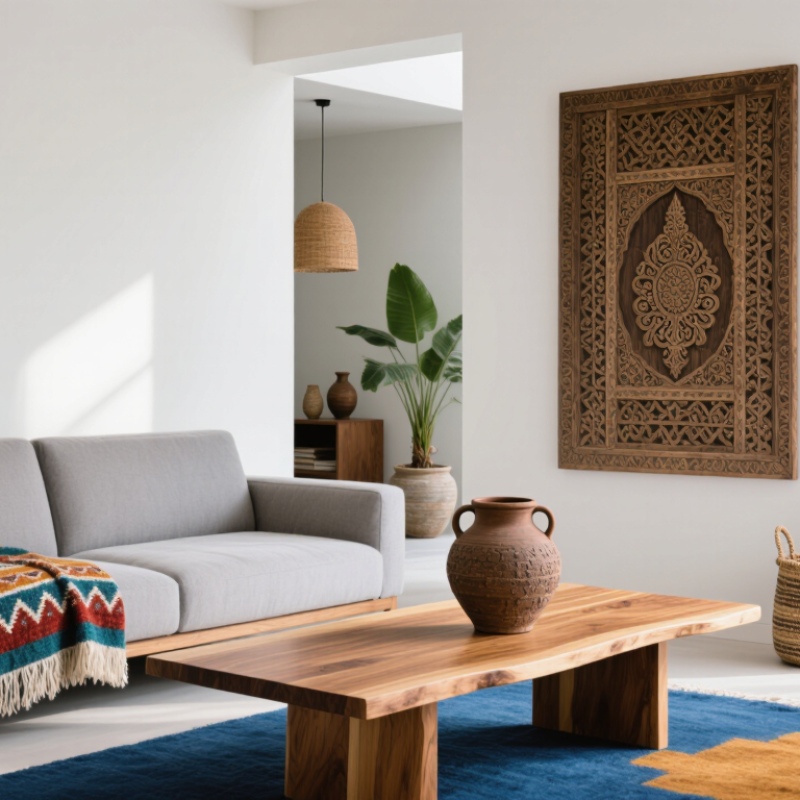
Cultural crafts are more than decorative accents. They carry knowledge of local materials, techniques, and daily life. In contemporary interiors, they can add texture and meaning without making a room feel like a museum. A handwoven basket beside a plain oak bench, for example, brings visible texture into a restrained space. Scale matters. One carefully placed object often reads more clearly than a crowded shelf of unrelated pieces.
The wider creative economy gives useful context, though it does not measure craft sales alone. UNESCO’s 2022 Re|Shaping Policies for Creativity report estimates that cultural and creative industries contribute 3.1% of global GDP and employ 6.2% of the workforce. UNCTAD’s Creative Economy Outlook 2022 reports $524 billion in global creative-goods exports in 2020. These broad figures show economic reach, not the income received by any particular maker. That distinction matters.
For a thoughtful interior, consider who made an object, what materials it uses, and whether its story is known. Pair carved wood or patterned cloth with quieter surfaces, such as plaster walls or linen upholstery. Leave space around detailed pieces so their forms remain legible. A common mistake is treating a craft as a color match alone. If its origin is uncertain, be honest about that; visual appeal does not replace context, and even a well-intended display can flatten a complex tradition.
Understanding the Role of Cultural Crafts in Contemporary Interior Design
| Tip | Cultural Craft Example | Region of Origin | Traditional Materials | Distinctive Technique or Feature | Contemporary Interior Application | Responsible Design Consideration |
|---|---|---|---|---|---|---|
| 1. Start With One Focal Piece | Handwoven Berber-style rug | North Africa, especially Morocco | Sheep wool and cotton | Geometric motifs, raised pile, and irregular handwoven texture | Use as an anchor in a living room, bedroom, or quiet reading area | Learn the design’s cultural context and avoid presenting sacred or symbolic motifs as generic decoration |
| 2. Layer Natural Textures | Japanese bamboo basketry | Japan | Bamboo and natural fiber | Split bamboo strips woven into lightweight, breathable forms | Combine baskets, trays, and lampshades with smooth wood, stone, or linen | Keep bamboo away from prolonged dampness and direct heat to reduce cracking and mold risk |
| 3. Use Color With Intention | Indian block-printed textiles | India, including Rajasthan and Gujarat | Cotton or silk and natural or synthetic dyes | Repeated patterns stamped by hand with carved wooden blocks | Introduce color through cushions, curtains, table linens, or a single accent chair | Wash according to the maker’s instructions because some dyes may fade with heat, sunlight, or harsh detergents |
| 4. Highlight Handmade Imperfections | Korean onggi-inspired ceramic vessels | Korea | Clay and glaze | Hand-shaped forms, breathable earthenware traditions, and subdued surfaces | Display as sculptural objects on open shelving, consoles, or dining tables | Confirm whether a vessel is food-safe or watertight before using it for food or fresh flowers |
| 5. Connect Craft to Function | Mexican Talavera-style ceramic tile | Mexico, with historical links to Spanish ceramic traditions | Fired clay and glaze | Hand-painted patterns, glossy glaze, and strong color contrast | Use selectively for a backsplash, fireplace surround, stair risers, or a framed wall panel | Check tile ratings, sealing requirements, and installation suitability for wet or high-traffic areas |
| 6. Balance Old and New Forms | West African mud-cloth-inspired textile | Mali and neighboring parts of West Africa | Cotton cloth and mud-based dyes or pigment systems | Graphic black, white, or earth-toned patterns with symbolic visual language | Pair a textile wall hanging or cushion with clean-lined sofas and contemporary furniture | Describe the piece accurately and distinguish authentic handmade textiles from mass-produced imitations |
| 7. Design for Longevity | Scandinavian-style traditional wood carving | Northern Europe, including Sweden, Norway, Denmark, and Finland | Locally available woods such as pine, birch, and spruce | Visible grain, hand-cut details, and practical objects shaped for everyday use | Choose carved stools, bowls, handles, or wall objects that can move between rooms over time | Prefer repairable, well-finished pieces and maintain wood with appropriate oil or wax when recommended |
Check the room’s colors, materials, and available space. Measure the wall or shelf, and view the area in morning and evening light. A small bowl may fit a quiet shelf; a carved screen needs more room.
Ask who made it, where it comes from, and what it was made for. Learn what its symbols mean when possible. Don’t guess. Some pieces carry meanings that casual display may overlook.
Match color before pattern. A terracotta vessel can echo warm flooring, while indigo may sit well against cool gray walls. Pair rough fibers with smooth plaster or pale wood.
Consider its everyday function, stability, cleaning needs, and expected wear. A basket can hold blankets, while a carved bowl may hold fruit. Beautiful objects are not always practical.
Keep them away from direct sunlight, damp walls, and kitchen grease. Check light and humidity regularly. I learned this the hard way; one sunny window faded a handwoven cloth within months.
Place ceramics on stable, padded shelving. Avoid harsh cleaners on painted surfaces. For heirlooms or delicate materials, seek care guidance suited to the object’s history.
Record the maker, community, date, materials, purchase history, and care instructions. Save photographs and notes in a secure digital folder. Include gift or inheritance details when known.
Leave space around it so viewers can notice its workmanship without touching it. Add an accurate description when appropriate, and remain open to correction and continued learning.
How To Blend Cultural Crafts In Modern Homes begins with understanding how handmade objects can add history, identity, and warmth to contemporary interiors. Start by assessing your home’s existing style, available space, colors, materials, and natural focal points. Then choose authentic cultural crafts that complement modern functions without making the room feel crowded. Consider texture, scale, and purpose when selecting textiles, ceramics, carvings, baskets, or other meaningful pieces.
Successful styling depends on balance and thoughtful contrast. Group items in varied heights, leave enough space around each piece, and use one or two standout objects as visual focal points. Mix traditional details with simple modern furniture to create harmony rather than a themed display. Finally, protect crafts from excessive sunlight, moisture, and dust, and keep records of their origin, maker, materials, and cultural significance whenever possible. Displaying these pieces respectfully helps preserve their value while allowing their stories to enrich everyday living.

 RUX Home Crafts